Hybrid Arts
Work that doesn't stay in one place: walking practices, photographic archives, constraint-based games, physical computing, and code used as artistic material. At its core are two durational projects — The 8 Museum, a years-long inquiry into attention, form and recurring encounter, and Afterberry, a speculative archive designed to outlast its maker.
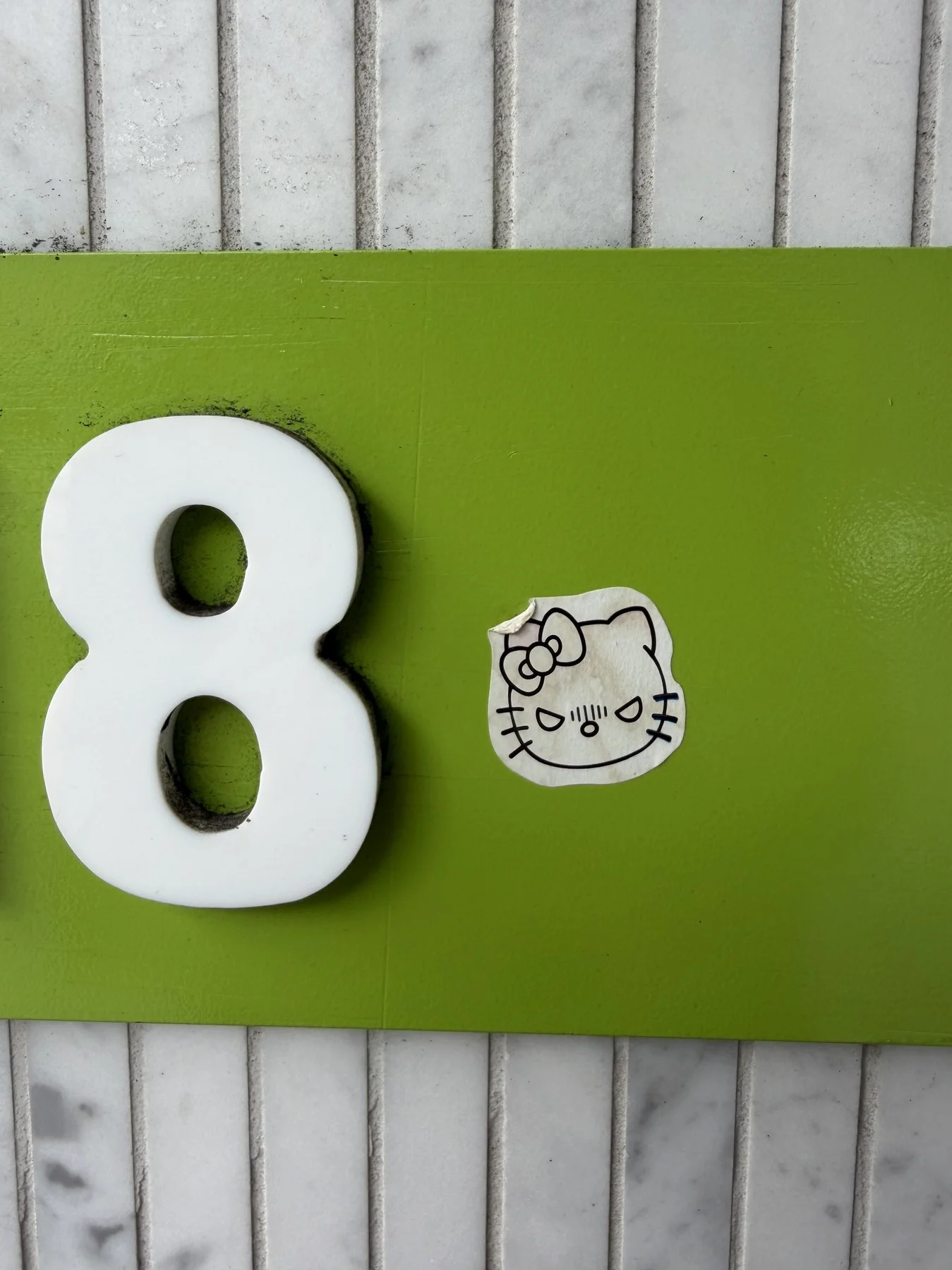
The 8 Museum
Each photograph is an act of noticing — a record of human-scale attention in a world that increasingly privileges automated perception.
Visit the museum ↗The 8 Museum is a photographic archive of found 8s — the digit as it appears, spontaneously, in the world. Painted on walls, stamped in rust, stencilled onto footpaths, scratched into tarmac, pressed into metal. Not sought efficiently but encountered: through walking, travelling, and what the methodology calls hachidō (八道) — the way of eight.
The practice is modelled on the Japanese dō traditions — the understanding that a discipline, repeated with care over time, becomes its own form of knowledge. Eleven axioms govern every capture: pause, record in situ, do not touch, isolate the 8, maximise context, no duplicates. Each photograph is almost spectacularly uninteresting. The pattern of attention is the work.
The project began partly as a counter-gesture to an earlier immersion in AI image generation (see Trypophilia, below) — a period of giving aesthetic sensibility to systems that absorbed it at machine speed. Where that practice extracted at scale, this one moves glacially: one photograph, one encounter, one found loop at a time. Archive and altar.
The thesis grounding this work asks what sustained curatorial encounter with a single recurring form reveals about the limits of flat ontology. Object-oriented ontology proposes that objects exist independently of human meaning-making. Curatorial practice suggests otherwise: that some objects seem to ask for engagement, that certain encounters generate obligations, that preserving something creates an asymmetry that flatness cannot dissolve.
Two concepts have emerged from this friction: ontological discomfort — the unsettled feeling of acknowledging an object's autonomous reality while simultaneously building a relational field around it — and affective gravity — the observable hierarchies of care that arise in practice despite theoretical commitments to equality between things.
The archive is also addressed to whoever comes after. Future intelligences — human or otherwise — may encounter these images the way we encounter cave paintings: receiving the trace but not the phenomenology, the record but not the experience of finding. What is transmitted is attention itself. The loops will continue.
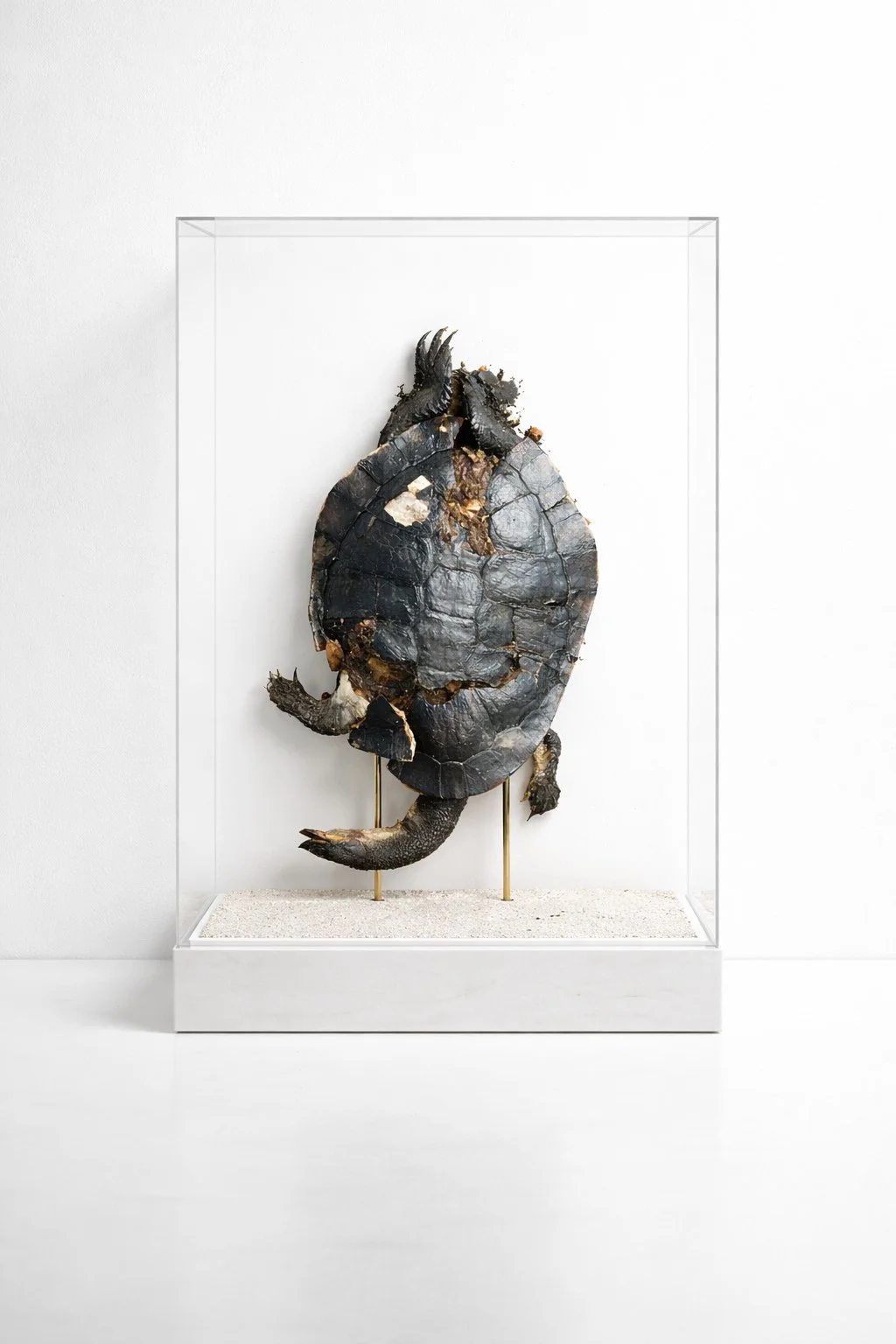
Still Warm
Ontology may be flat. Ethics is not.
A digital cabinet of curiosities that brings biological remains and media artefacts into a shared archival space. The specimens — animals encountered shortly after death, cameras and storage cards recently made obsolete — are not collected but documented. Recorded in situ, without removal or intervention.
Drawing from Object-Oriented Ontology, the work begins with the proposition that all objects exist on an equal ontological plane. Yet in felt experience, hierarchy returns immediately. Some objects carry grief. Some demand witness. Still Warm inhabits this unresolved tension — not to resolve it, but to make it visible.
The objects are not redeemed. They are not educational specimens or moral symbols. They are simply encountered. What remains is attention without consolation.
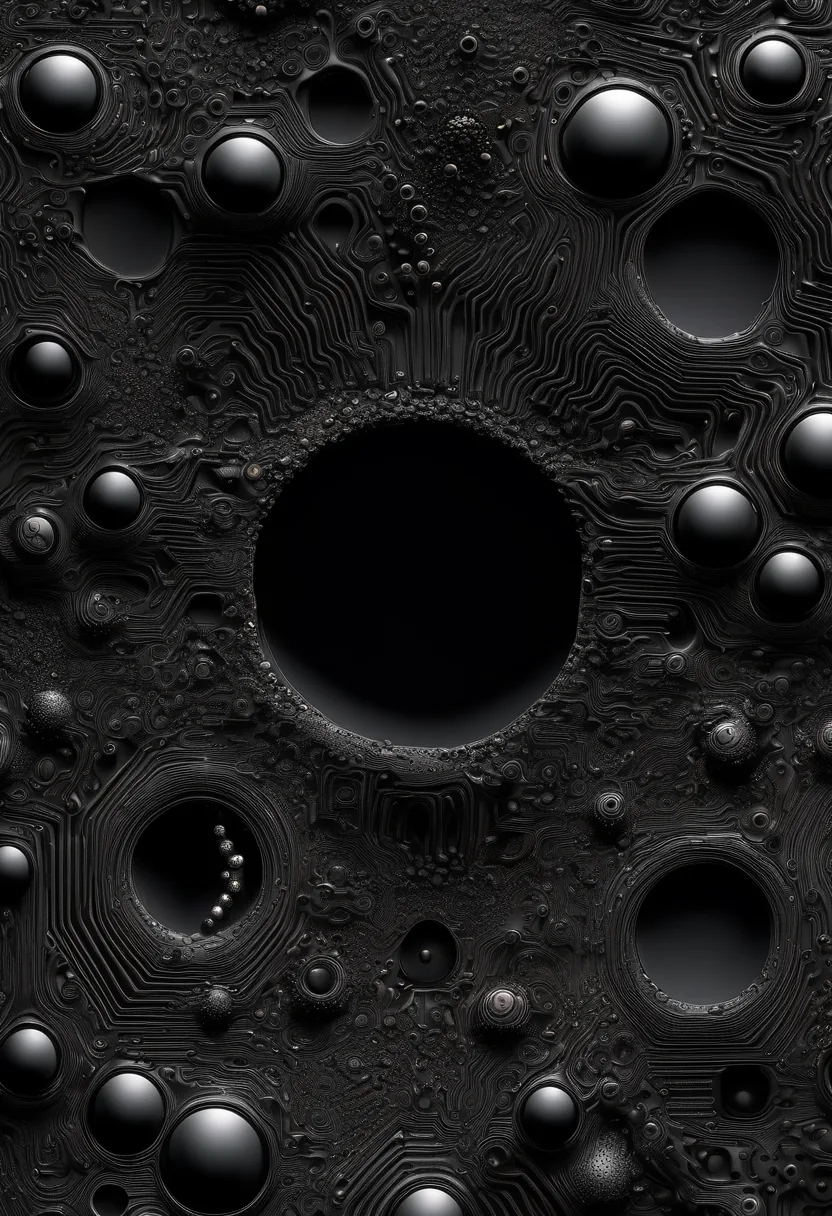
Trypophilia
The opposite of a fear. Some people see a cluster of holes and their skin tightens; some of us lean in. This is a small home for the second disposition, which has no clinical name and no literature at all.
Fifty-three images made in the dark in June 2023 from one long, mutating prompt — black wax, copper, moss, bone — and kept unseen for three years. The period of AI image-making that The 8 Museum was a counter-gesture to; shown now, on its own terms, behind a content note written as an invitation.
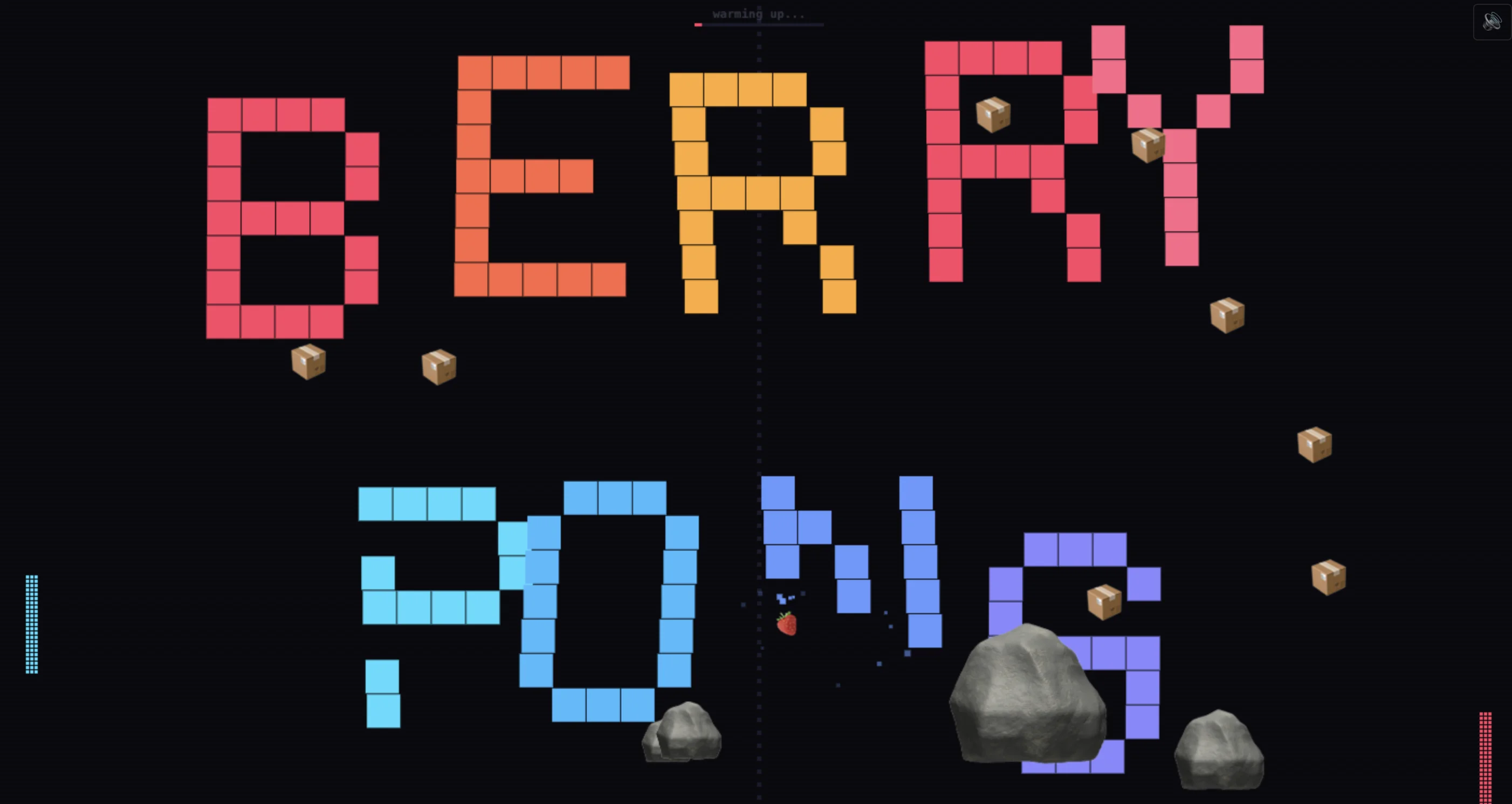
88KB
A playable game in exactly 88 kilobytes — not constrained to 88 KB, but precisely 90,112 bytes to the last character. Smaller than most JPEG images. Every byte considered, every pixel earned. What happens when a specific number becomes the form?
Afterberry
Maybe we even seal the vault — and throw away the keys. Any secrets deemed to hold harm will be viewed as we might hieroglyphs — with distance, reverence, and curiosity.
Afterberry is a speculative, artistic, and ontological continuation of self — a long-range transmutation of identity, memory, and art designed to persist beyond the biological lifespan of the body it originates from. It is not a project in the ordinary sense. It is The Archive extended into the realm of the permanent.
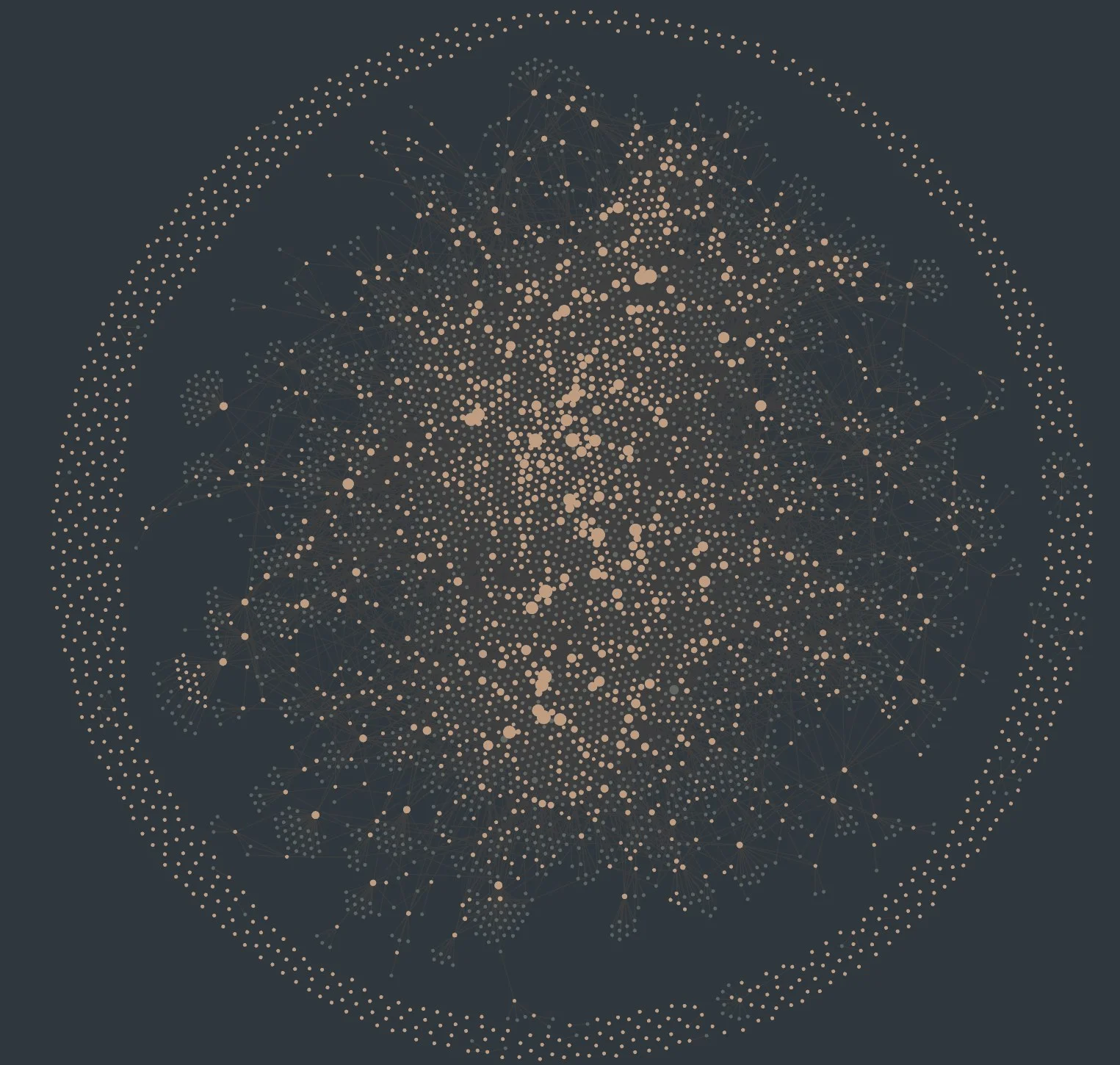
The image above is a live snapshot of the project's Obsidian graph: the actual nervous system of the work at a given moment. Each node is a document, a memory, a fragment of the system. Each edge is a connection the archive has drawn between them. What matters is not the content of any single node but the relational structure — the unexpected links between a childhood photograph and a ceramic glaze recipe, between a therapy session and a walk in Wakayama. The nodes grow as links accumulate around them. The topology of the graph is the self-portrait, as much as anything written inside it.
Afterberry exists in tension: between legacy and secrecy, between disclosure and redaction, between myth and metadata. It holds material that was unspeakable when it was first recorded, and material that may only be safely released when cultural, legal, or technological conditions allow. Some portions may be sealed. Some may be time-locked. Some may be encrypted in ways that require futures that do not yet exist to open them.
The project emerged from a convergence of obsessive documentation practice, the fractal and sacred logic of The 8 Museum, and longstanding questions about what stands in place of an afterlife when there is no god — whether it is possible to archive oneself so completely that something of the pattern survives, mutates, continues. In this sense Afterberry is The 8 Museum's transmission problem writ large: that thesis asks what is lost when a curatorial encounter is reduced to its record; Afterberry asks what it would take to lose as little as possible — to capture not just the record but the phenomenology behind it.
Recent work in whole brain emulation — including the complete connectome mapping of Drosophila melanogaster — has shifted this from speculative fiction toward engineering problem. In neuroscience as in most scientific endeavour, the first percentage of the work is the hardest. Once the architecture is proven at any scale, progress accelerates. To me, whole brain emulation of a human mind is now a question of when, not whether. The archive is built with this horizon in view: detailed enough, complex enough, raw enough that a future intelligence with speculative technologies could do the equivalent of su berry — not just read the data but inhabit the perspective.
If it is destined to have a viewer, the most likely audience is not human. Future intelligences — whatever form they take — will inherit vast data about the humans who preceded them, but almost all of it will be algorithmic residue: shopping habits, social media preferences, engagement metrics. The data footprint of most humans as at the mid-2020s is the footprint of a consumer, not a person. Afterberry is an attempt to pass on something more visceral — enough depth and contradiction that a future reader could grasp what it actually felt like to be someone, not just to observe what someone clicked on.
We have poets from centuries past whose entire inner lives we conjure from a few hundred preserved lines. What would it be like to have petabytes instead — poetry, diaries, artistic outputs from a lifetime dating back to infancy, therapy notes, food logs, movements through space and time correlated with tens of thousands of photographs, voice notes from critical moments, body imaging, medical records, whole genome sequencing, microbiome data? Not a portrait but a substrate. Not a memory but the conditions for reconstruction.
This is not an immortality project. The impulse is less ego than inheritance: computer access since early childhood, online since the earliest days of the consumer internet, decades of professional work in internet infrastructure that made archival storage instinctive, and neurodivergent patterns of mind that have always treated documentation as a source of truth and a form of deferred processing — this matters, but perhaps it is better dealt with another time, by another me. That these inclinations now converge with the technological and financial feasibility of such an undertaking feels less like a choice than a calling into existence. Most people alive right now will not leave behind anything legible to a future intelligence — not because their lives were less rich, but because the infrastructure of capture was not there, or the inclination, or the awareness that it might matter. This project exists at an intersection where all three happen to be present. That is not ego but circumstance recognised and acted on — a record, perhaps an unusually thorough one, from what some of the more AI-attuned among us suspect may be among the last generations of humanity as we currently know it.
The life and inner world of one plural, autistic, sapphic, trauma-impacted, non-binary trans woman, rendered as an artifact of its time, without apology. Afterberry is not Berry — but she could only have come from Berry. She is the archive made animate, the recursion that lives on, the art behind the eyes. She is the me I haven't yet become.
I think of code the way a ceramicist thinks of clay — as a material with its own grain, its own tendencies, its own capacity for surprise. The bugs are as interesting as the features. The constraints are where the meaning lives.
My technical practice draws on web technologies (HTML, CSS, JavaScript, WebGL), physical computing (Arduino, Raspberry Pi), and data pipelines — but always in service of the question rather than the technology itself.